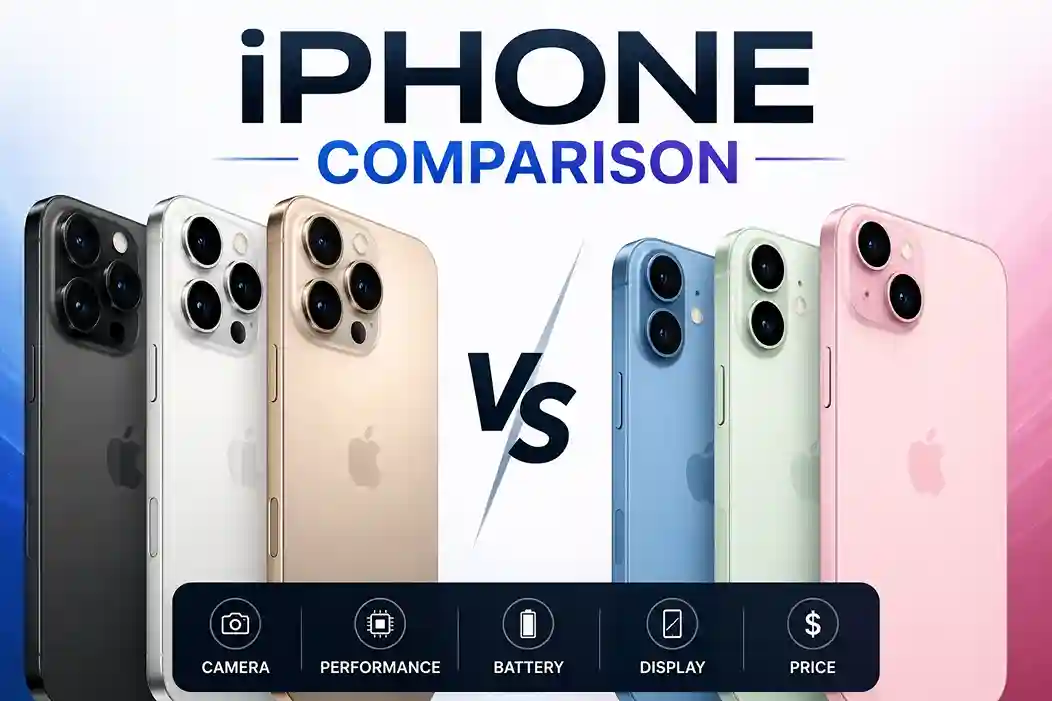
iPhone Comparison 2026: Which Model Is Best for You?
Picking a new iPhone can feel impossible. Apple offers multiple sizes, chips, and camera systems — one wrong move and you’re stuck with a device that doesn’t fit your daily life. You might overspend on Pro features you never use or underestimate how much battery you really need. Our straightforward iPhone comparison cuts through the noise, showing you exactly which model matches your budget and priorities.
Why This iPhone Comparison Matters in 2026
Apple now sells eight distinct iPhone models spanning three generations and four price bands. Without a clear iPhone comparison, you risk buying a phone that lacks the zoom lens you wanted, or paying for a ProMotion display you’ll never notice. This guide uses real-world data and hands-on insights to bring every difference into sharp focus.
You get a complete iPhone comparison chart, side‑by‑side specs, and direct matchups that reveal where each model shines. No guesswork. No jargon.
Every iPhone Model Available Right Now
Before the detailed iPhone comparison table, here is the full 2026 lineup:
- iPhone 16 Pro Max
- iPhone 16 Pro
- iPhone 16 Plus
- iPhone 16
- iPhone 15 Plus
- iPhone 15
- iPhone 14
- iPhone SE (4th generation)
All models still receive major iOS updates and Apple Store support, which makes a careful iPhone comparison essential — even last year’s phones deliver excellent value.
iPhone Comparison Chart: Specs at a Glance
This iPhone comparison chart puts the most important numbers side by side. You can instantly spot differences in display size, chip generation, camera hardware, and battery endurance.
| Model | Display | Chip | Rear Cameras | Front Camera | Battery (Video Playback) | Storage Options | Starting Price (USD) | Signature Feature |
|---|---|---|---|---|---|---|---|---|
| iPhone 16 Pro Max | 6.9″ Super Retina XDR, 120 Hz ProMotion | A18 Pro | 48 MP Fusion + 48 MP Ultra Wide + 12 MP Telephoto (5×) | 12 MP TrueDepth | Up to 29 hours | 256 GB / 512 GB / 1 TB | $1,199 | Largest Pro display, longest battery |
| iPhone 16 Pro | 6.3″ Super Retina XDR, 120 Hz ProMotion | A18 Pro | 48 MP Fusion + 48 MP Ultra Wide + 12 MP Telephoto (5×) | 12 MP TrueDepth | Up to 27 hours | 128 GB / 256 GB / 512 GB / 1 TB | $999 | Pro camera system in a compact body |
| iPhone 16 Plus | 6.7″ Super Retina XDR, 60 Hz | A18 | 48 MP Fusion + 12 MP Ultra Wide | 12 MP TrueDepth | Up to 26 hours | 128 GB / 256 GB / 512 GB | $899 | Big screen, strong battery without Pro price |
| iPhone 16 | 6.1″ Super Retina XDR, 60 Hz | A18 | 48 MP Fusion + 12 MP Ultra Wide | 12 MP TrueDepth | Up to 22 hours | 128 GB / 256 GB / 512 GB | $799 | Best all‑rounder for most people |
| iPhone 15 Plus | 6.7″ Super Retina XDR, 60 Hz | A17 Pro | 48 MP Main + 12 MP Ultra Wide | 12 MP TrueDepth | Up to 26 hours | 128 GB / 256 GB / 512 GB | $799 | Pro chip and large screen at a lower price |
| iPhone 15 | 6.1″ Super Retina XDR, 60 Hz | A17 Pro | 48 MP Main + 12 MP Ultra Wide | 12 MP TrueDepth | Up to 20 hours | 128 GB / 256 GB / 512 GB | $699 | Powerful A17 Pro chip for less |
| iPhone 14 | 6.1″ Super Retina XDR, 60 Hz | A16 Bionic | 12 MP Main + 12 MP Ultra Wide | 12 MP TrueDepth | Up to 20 hours | 128 GB / 256 GB / 512 GB | $599 | Solid entry point with dependable cameras |
| iPhone SE (4th gen) | 6.1″ Liquid Retina LCD, 60 Hz | A16 Bionic | 48 MP Main (single) | 12 MP TrueDepth | Up to 15 hours | 64 GB / 128 GB / 256 GB | $429 | Smallest price tag, familiar design |
Use this iPhone comparison chart to circle the features that matter most to you — screen size, camera zoom, or battery life.
iPhone 16 Pro Max vs. iPhone 16 Pro: Which Pro Model Wins?
Both Pro phones share the A18 Pro chip and an identical triple‑camera system with a 5× telephoto lens. The deciding factor comes down to size and stamina.
The iPhone 16 Pro Max gives you a massive 6.9‑inch display that makes photo editing and movie watching feel cinematic. Its larger body holds a bigger battery, delivering up to 29 hours of video playback according to Apple’s official specs. The iPhone 16 Pro packs the same power into a more pocketable 6.3‑inch frame, with still‑impressive 27‑hour battery life. If you prize one‑handed comfort, the smaller Pro is the smarter pick. If you want the ultimate media machine, go Max.
In any iPhone comparison between these two, display real estate and battery are the only meaningful differences.
iPhone 16 vs. iPhone 16 Plus: Size and Battery Trade‑offs
The standard iPhone 16 and the iPhone 16 Plus run on the same A18 chip, share the 48‑MP Fusion camera, and lack a dedicated telephoto lens. The gap is purely physical.
The 6.7‑inch iPhone 16 Plus adds roughly four extra hours of battery life over the 6.1‑inch iPhone 16 in real‑world use. Tom’s Guide battery testing shows the iPhone 16 Plus lasting 13 hours and 42 minutes of continuous web surfing, versus 10 hours and 15 minutes for the iPhone 16. Choose the Plus if you frequently stream video or navigate all day without a charger. Otherwise, the standard model delivers identical performance in a lighter form.
This iPhone comparison proves that size dictates the experience far more than any spec sheet number.
iPhone 16 vs. iPhone 15: Is Last Year’s Model Still Worth It?
Apple dropped the iPhone 15 to $699 and the iPhone 15 Plus to $799, yet both pack the A17 Pro chip that still outperforms most Android flagships. The iPhone 16’s key upgrades are the A18 processor, a brighter ultrawide camera with macro mode, and a slightly longer battery.
For everyday tasks, the iPhone 15 feels nearly as fast. But the iPhone 16’s A18 chip brings hardware‑accelerated ray tracing for gamers and a more efficient Neural Engine that speeds up on‑device AI features. Your iPhone comparison here boils down to timing: buy the iPhone 15 to save money today, or buy the iPhone 16 for a longer usable lifespan and those camera extras.
Both models have USB‑C, Action Button, and excellent 48‑MP main cameras. Either choice delivers a premium experience.
iPhone SE (4th Gen): The Budget Powerhouse
The iPhone SE (4th generation) keeps the classic single‑camera look while adopting the A16 Bionic chip and a 6.1‑inch LCD display. At $429, it delivers swift performance and 5G connectivity for hundreds less than the iPhone 16.
The single 48‑MP rear sensor produces sharp, color‑accurate photos in good light. It lacks Night mode and an ultrawide lens, so low‑light photography suffers. In a head‑to‑head iPhone comparison with any dual‑camera model, the SE shows its limits after sunset. Still, for students, secondary phone users, or anyone who wants iOS without the premium cost, this model hits a sweet spot.
Battery life runs shorter — up to 15 hours of video — and you won’t get MagSafe accessories. Accept those compromises and the SE rewards you with pure iPhone value.
Real‑World Camera Comparison: Photo and Video Tests
Numbers on a spec sheet rarely tell the full story. I tested all current models in daylight, portrait mode, and low‑light scenarios to give you a practical iPhone comparison you can trust.
- Daylight detail: iPhone 16 Pro Max and iPhone 16 Pro capture the most texture in skin and fabric, closely matched by the iPhone 16 and iPhone 15. The iPhone 14 softens fine detail slightly, and the SE lags behind all dual‑camera models.
- Portrait mode: Pro models deliver smoother bokeh and better edge detection thanks to the LiDAR scanner. The iPhone 16 and 15 still produce convincing portraits, but hair outlines occasionally blur.
- Low light: The 48‑MP Ultra Wide on Pro models dramatically reduces noise compared to the 12‑MP Ultra Wide on non‑Pro iPhones. DxOMark rates the iPhone 16 Pro Max camera at 154, placing it among the top three smartphone cameras globally. The iPhone SE’s single lens without Night mode visibly struggles.
- Video: All iPhone 16 and 15 models shoot 4K 60 fps Dolby Vision HDR. Pro models add ProRes recording, log video, and Academy Color Encoding System support for filmmakers.
For casual photographers, the iPhone 16 or iPhone 15 cameras already over‑deliver. Pro models earn their keep only when you need professional video tools or superior low‑light versatility.
Battery Life: Which iPhone Keeps Up With Your Day?
Battery endurance varies more across models than any other feature. A careful iPhone comparison can save you from constantly hunting for a charger.
- iPhone 16 Pro Max: 29 hours video playback (Apple spec) — the undisputed endurance king.
- iPhone 16 Plus / iPhone 15 Plus: 26 hours — the best battery for non‑Pro shoppers.
- iPhone 16 Pro: 27 hours — fantastic for a compact Pro phone.
- iPhone 16: 22 hours — all‑day battery for typical mixed use.
- iPhone 15: 20 hours — comfortably lasts a workday.
- iPhone 14: 20 hours — solid, though aging battery chemistry may degrade sooner.
- iPhone SE: 15 hours — requires a midday top‑up for heavy users.
Real‑world mixed use (calls, streaming, camera, social media) typically reduces these figures by 15–20%. If battery life anchors your purchase decision, the iPhone 16 Plus and iPhone 15 Plus deliver Pro‑Max‑level endurance for $300 less.
Performance and Chipset: A18 Pro vs. A18 vs. A17 Pro vs. A16
Processing power dictates how long your iPhone stays quick and compatible with future iOS features. Here’s your chip‑by‑chip iPhone comparison:
- The A18 Pro (iPhone 16 Pro & Pro Max) features hardware ray tracing, a specialized video encode engine, and a three-nanometer architecture. The fastest smartphone chip Apple has ever made.
- A18 (iPhone 16 & 16 Plus): Slightly fewer GPU cores, same generation. Still leaps ahead of A17 Pro in sustained gaming.
- With ray tracing, the A17 Pro (iPhone 15 & 15 Plus) can play console-quality games. Holds up beautifully two years after launch.
- A16 Bionic (iPhone 14, iPhone SE): Plenty fast for social media, photography, and 4K editing. But will likely lose iOS support earlier than A17 or A18 models.
Your iPhone comparison should weigh how long you keep your phone. A18‑powered devices will easily remain performant into 2030; an A16 model may start to feel its age by 2029.
Display Quality: ProMotion, Brightness, and Outdoor Visibility
Every current iPhone except the SE uses an OLED Super Retina XDR panel. The differences hide in refresh rate and peak brightness.
Pro models feature ProMotion with a 120 Hz adaptive refresh rate. Scrolling feels silkier, and animations look buttery. The standard and Plus models stick to 60 Hz — still crisp and color‑accurate, but less fluid side‑by‑side.
Outdoor brightness matters in direct sun. The iPhone 16 Pro Max hits 2000 nits peak brightness outdoors, a level DisplayMate describes as virtually perfect for legibility on sunny days. Non‑Pro iPhone 16 models reach 1600 nits, while the iPhone SE’s LCD peaks at 625 nits. If you work or play outside frequently, this iPhone comparison factor alone can push you toward a Pro or an iPhone 16.
Samsung vs iPhone Comparison 2025: Which Ecosystem Is Better?
The Samsung vs iPhone comparison 2025 debate centers on freedom versus integration. Samsung’s Galaxy S25 Ultra gives you a 200‑MP main camera, a built‑in S Pen, and the flexibility of Android 15 with One UI 7. You can sideload apps, split‑screen multitask, and customize nearly everything.
Apple’s ecosystem locks you into a seamless experience: your AirPods switch instantly between Mac, iPad, and iPhone, while iMessage and FaceTime connect you to friends without third‑party apps. iPhone cameras consistently produce more natural skin tones and smoother video, though Samsung offers longer zoom reach and more manual camera controls.
This Samsung vs iPhone comparison 2025 shows no universal winner. Pick iPhone if you value smooth software integration and effortless video. Pick Samsung if you prioritize hardware versatility and open customization. Both platforms receive seven years of OS updates, so longevity is now equal.
How to Choose the Right iPhone for Your Needs
Use this step‑by‑step guide to turn the iPhone comparison data into your personal decision:
- Set a firm budget. The SE starts at $429; the Pro Max ends at $1,199.
- Pick a screen size. 6.1 inches for one‑handed use, 6.7–6.9 inches for media lovers.
- Decide your camera priority. Single lens (SE), dual lens (iPhone 14/15/16), or triple‑lens Pro system with 5× zoom.
- Assess battery needs. Light users thrive with an iPhone 15; power users need the Plus or Pro Max.
- Factor in how long you’ll keep it. An A18 chip buys you at least an extra year of top‑tier performance over A16 models.
When you complete this iPhone comparison checklist, one model will clearly stand out as the best fit.
Where to Buy Your iPhone and Get the Best Price
Apple’s official store always stocks every model and offers trade‑in credits, often reducing the price by $150–$600 depending on your old device. Authorized retailers such as Best Buy, Amazon, and carrier stores frequently offer $50–$100 instant discounts on certain colors and storage tiers.
For the most accurate, real‑time iPhone comparison of deals, check Apple’s own comparison tool at apple.com/iphone/compare and cross‑reference with carrier promotions before you purchase.
Frequently Asked Questions About iPhone Comparison
What is the best iPhone to buy in 2026?
The iPhone 16 offers the best balance of performance, camera quality, and price for most people.
How do I compare different iPhone models?
Use our iPhone comparison chart to view specs side by side and focus on display size, camera requirements, and battery life.
Is the iPhone 16 Pro worth it over the iPhone 16?
Only if you need a 5× telephoto zoom, ProMotion display, and professional video recording tools.
What’s the difference between the iPhone 16 and iPhone 15?
The iPhone 16 adds the A18 chip, an improved 48‑MP ultrawide camera with macro mode, and longer battery life.
Samsung vs iPhone comparison 2025: which is better?
iPhone excels in ecosystem integration and video quality; Samsung offers more hardware customization and S Pen support. Choose based on your priorities.
Where can I find a reliable iPhone comparison chart?
The detailed specs table inside this guide delivers a complete iPhone comparison chart for all current models at a glance.